If you have ever looked up at a grey sky and wondered whether your solar panels are doing anything, you are not alone. It is one of the first questions homeowners ask before going solar, and a fair one. Spending thousands of dollars on a system that only works on sunny afternoons would make it a poor investment.
So let’s answer it properly. Do solar panels work at night? No, and there is a clear scientific reason for that. Do solar panels work on cloudy days? Yes, though not at full capacity. Understanding both answers helps you set realistic expectations and make smarter decisions about battery storage, net metering, and overall system design.
This blog breaks down exactly how solar panels behave when the sun is not cooperating, and what you can do to keep your home powered regardless.
Do Solar Panels Work on Cloudy Days?
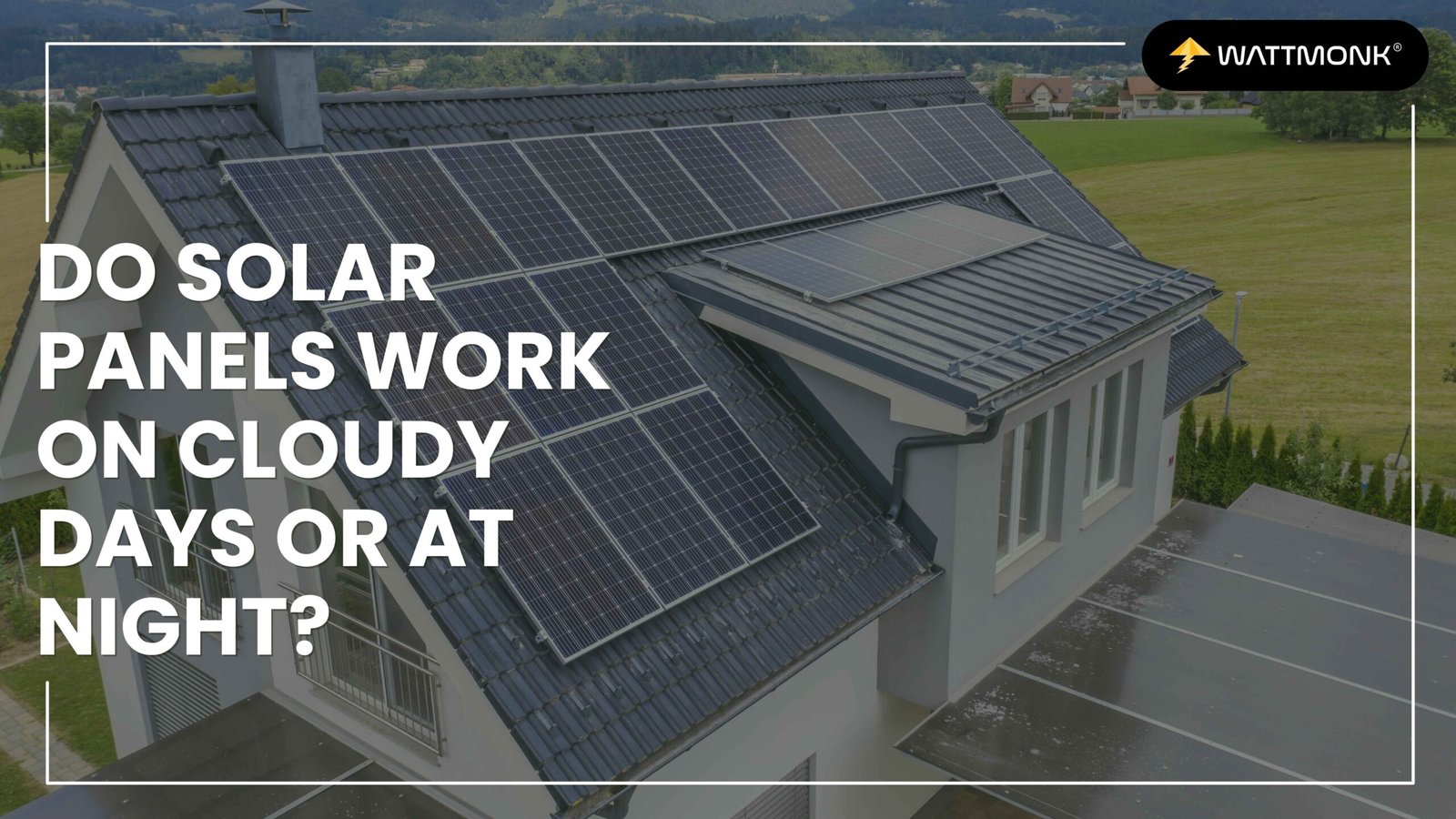
Yes, solar panels work on cloudy days. They do not need direct sunlight to generate electricity, they need light. Even on an overcast day, sunlight filters through cloud cover as diffuse light, and your panels pick that up and convert it into usable electricity. That said, reduced light does mean reduced output.
Under heavy cloud cover, solar panels can drop to as low as 10 to 25 percent of their rated capacity, based on findings from a University of Port Harcourt study on monocrystalline panels. Light cloud cover causes a smaller dip, and in some cases the edge of cloud effect actually pushes output briefly higher as sunlight bends around cloud edges and concentrates on the panel surface. So the relationship between clouds and solar output is not always straightforward.
What is straightforward is the real world evidence. Germany consistently ranks among the top solar energy producers globally despite having weather patterns closer to Seattle than Phoenix. If solar panels could not generate power on cloudy days, that simply would not be possible. Millions of homes in overcast climates run on solar, and that number keeps growing.
How Much Power Do Solar Panels Produce on Cloudy Days and in Winter?
Beyond that 10 to 25 percent drop, real world output on cloudy days often lands higher depending on cloud density, panel type, and how your system is oriented. Monocrystalline panels, which are the most common in residential installations today, handle diffuse light better than older polycrystalline models, so panel choice does make a difference in low light conditions.
Winter adds another layer to this. Many homeowners assume colder months mean less solar production, but temperature and sunlight are two different things. Solar panels actually perform slightly better in cold weather because heat reduces electrical efficiency. The bigger concern in winter is shorter daylight hours and more frequent cloud cover, not the cold itself. A well angled system on a clear winter day can produce close to its rated output.
Snow is worth mentioning too. A light dusting tends to slide off angled panels fairly quickly, but heavy accumulation can block light entirely until it clears. In regions with harsh winters, panel tilt angle becomes an important design consideration to minimize snow buildup and maintain consistent energy production through the low light months.
Do Solar Panels Work at Night?
This is where the answer changes. Do solar panels work at night? No. Unlike cloudy days where diffuse light still reaches the panels, nighttime means no light at all. Solar panels work through the photovoltaic effect, where photons from sunlight knock electrons loose in the panel’s semiconductor material to create a current. No photons, no current. That is the physics, and there is no workaround for it.
Which is exactly why storage and grid connection matter. A solar setup with neither would leave you without power after sunset. Most homeowners do not realise this gap exists until they start planning their system.
Outdoor solar lights and solar lawn lights handle this differently. They carry small built-in batteries that charge through the day and draw down after dark. On cloudy days they still charge, just slower, which is why a string of overcast days might dim them slightly but rarely knock them out completely.
How Do Homes Use Solar Power at Night?
Since solar panels do not work at night, the question becomes where your power comes from after sunset. There are two main answers to that, and most residential systems use a combination of both.
The first is battery storage. A solar battery stores excess energy your panels generate during the day so you can draw on it at night. Systems like the Tesla Powerwall or Enphase IQ Battery have made home storage more accessible over the last few years, and pairing panels with a solar battery for nighttime solar power is increasingly the default recommendation for new installations. Do solar panels store energy for night use? Not directly, but a battery connected to your system does exactly that.
The second is net metering. Instead of storing excess daytime energy, you feed it back to the grid and earn credits from your utility provider. At night, you draw from the grid and those credits offset the cost. It is not free power, but it keeps your bill low without the upfront cost of a battery. How do solar panels produce electricity without sun in a net metering setup? They do not, but the credits they earned during the day do the work instead.
Which option makes more sense depends on your utility rates, how much your panels produce, and whether backup power during outages matters to you. Battery storage gives you true energy independence. Net metering keeps costs down with less complexity.
Tips to Maximize Solar Output on Low Light Days
Getting the most out of your solar system on cloudy days starts at the design stage, not after installation. A few decisions made early on have an outsized impact on how well your system handles overcast conditions.
- Choose monocrystalline panels. They consistently outperform other types in diffuse light, which is why they are the go to choice for installations in cloudier climates. If your region sees frequent overcast days, this is not a detail to overlook.
- Get your tilt and orientation right. Panels angled correctly for your latitude capture more available light year round, including on days when that light is scattered rather than direct. An installer who skips this calculation is leaving output on the table.
- Add battery storage. Even on days when your panels are generating at 15 to 20 percent capacity, that energy is worth capturing. A properly sized battery ensures do solar panels charge on cloudy days becomes less of a concern because whatever comes in gets stored and used.
- Keep your panels clean. Dust, debris and grime compound the effect of low light. A panel already working at reduced capacity does not need the additional drag of a dirty surface.
So, Do Solar Panels Work at Night or on Cloudy Days?
Cloudy days slow solar panels down, they do not stop them. Output drops, sometimes significantly, but a well designed system with the right panels and proper orientation will keep generating through overcast weather and even through winter. Do solar panels work at night? No, but that is a solvable problem. Battery storage and net metering exist precisely to fill that gap, and most modern installations account for both.
The bigger picture is this. Solar is not a fair weather technology anymore. Homes in some of the cloudiest regions in the world run on it reliably. The question is less about whether solar works in your conditions and more about whether your system is designed well enough to handle them. That starts with getting the details right from the beginning.