How Solar Plan Set Automation Can Help Installers Reduce Manual Work

Insights
Manual Work Inside a Solar System Design (And What PlanSetIQ Handles for You)
.jpg.jpeg)
Ask most solar business owners what slows their projects down, and they'll say permitting.
Ask their design team, and you'll get a more specific answer. It's not permitting. It's everything that has to happen before a solar system design is ready to submit.
What Is Solar System Design in the Context of Permitting?
Solar system design, in the context of residential and commercial permitting, refers to the creation of a complete permit package that documents the PV system configuration for AHJ and utility review. This includes the site layout, single-line diagram, load calculations, equipment schedules, NEC compliance notation, and utility interconnection documentation. The permit package must be accurate, internally consistent, and formatted to the specific requirements of the receiving Authority Having Jurisdiction.
What Does a Permit-Ready Solar System Design Include?
A permit-ready solar system design includes: (1) a site layout drawing with panel placement and setbacks, (2) a single-line diagram of the full electrical system, (3) load calculations, (4) equipment schedules listing inverter, modules, racking, and disconnects, (5) NEC compliance labels and legends, and (6) utility interconnection documentation. Every component must be consistent with the others — mismatches between documents are the primary trigger for AHJ correction notices.
What Actually Goes Into a Permit-Ready Solar System Design?
A completed solar system design isn't just a roof layout. It's a package — and every component of that package has to be accurate, consistent, and formatted to the requirements of the specific AHJ and utility receiving it.
The core components of a permit-ready solar plan typically include:
- Site layout drawing with panel placement, setbacks, and roof dimensions
- Single-line diagram showing the full PV system design electrical configuration
- Load calculations
- Equipment schedules listing inverter, modules, racking, and disconnect specs
- NEC compliance labels, legends, and code compliance notes
- Utility interconnection documentation
Each of these has to be consistent with the others. The equipment on the single-line diagram has to match the equipment schedule. The system size on the solar design drawing has to match what's on the interconnection application. The setbacks have to reflect the actual AHJ requirements for that jurisdiction.
Where Does Manual Labor Actually Live?
The design itself laying out panels, drawing the single-line, placing equipment is only part of the work. The bigger time drain is everything around it.
- Cross-referencing AHJ requirements: Every jurisdiction has its own checklist. Some require arc-fault protection notation. Some have specific labeling formats per NEC compliance standards. Some want utility interconnection disconnect placement called out in a specific way. A designer working across multiple jurisdictions has to verify solar permitting requirements for each project individually. There is no universal standard.
- Formatting spec sheets: Equipment cut sheets need to match what's called out in the PV system design. If the spec sheet format doesn't align with what the AHJ expects, it gets flagged. Pulling the right document, formatting it correctly, and confirming it matches the plan set takes time on every project.
- Catching mismatches before submission: Address discrepancies between the proposal and the solar design. Equipment listed in the permit package but not in the plan set. System sizes that don't match across documents. A solar designer doing this manually is doing it by memory and attention both of which degrade at volume.
- Annotating and finalizing the PDF: Notes, stamps, revision clouds, signature blocks. Every solar system design package needs a round of final annotation before it goes out. In most workflows, this happens in a separate application — which means another tool, another step, another potential for version errors.
Where Most Solar Teams Hit the Capacity Ceiling?
A team doing 20 solar system designs per month runs differently than a team doing 80.
At 20, a skilled solar designer can hold the AHJ requirements in their head. They know the quirks of the jurisdictions they work in. They can catch mismatches because they've seen the same solar permitting patterns before.
At 80, that breaks down. The solar designer can't hold 80 projects' worth of AHJ variation in working memory. Errors get through. Revisions come back. Solar permit turnaround time slips.
Most teams respond to this capacity ceiling in one of three ways:
- Hire another solar designer: Which works, but takes months and carries overhead — salary, benefits, ramp-up time, and the same capacity ceiling at higher volume.
- Outsource to a drafting vendor: Which transfers the work but not the visibility. The team loses control of turnaround time, revision cycles, and solar PV design output consistency.
- Slow down: Which means fewer projects, or longer timelines, or both.
None of these solve the underlying problem. The manual steps in solar PV system design don't compress, they just get distributed differently.
What PlanSetIQ Handles Automatically?
PlanSetIQ is built on 7+ years of solar engineering data and 125,000+ approved solar permit design submissions across 12,000+ AHJs and 500+ utilities. That foundation is what makes the automation specific to solar permitting rather than generic.
Here's what the platform handles that your team currently does manually:
AHJ and utility requirement mapping: PlanSetIQ maintains a live database of requirements for 12,000+ AHJs. When a project is run through the platform, the solar design output is validated against the specific requirements for that jurisdiction — not a generic national standard.
Guided design workflow via Copilot: The Copilot walks solar designers through each step of the plan set. No expert required. A coordinator or junior team member can produce a complete PV design without AutoCAD experience or years of solar permitting knowledge.
Automated QC before the package leaves: Every solar system design generated on PlanSetIQ runs through a QC check that looks for the common failure points — equipment mismatches, missing labels, setback errors, NEC compliance gaps, documentation gaps. Issues are flagged before submission, not after an AHJ correction notice.
Built-in PDF editor: Annotations, notes, revision clouds, and final formatting happen inside the platform. No secondary application, no version confusion, no separate export step for permit package management.
Consistent output across volume: Whether a team is producing 10 or 125 solar system designs per month, the QC layer applies the same checks to every project. Solar design quality doesn't degrade as volume increases.
Key Statistics
Metric
Figure
AHJs in PlanSetIQ database
12,000+
Utilities covered
500+
Approved solar permit design submissions
125,000+
Years of solar engineering data
7+
Estimated project cycle time improvement
10–20%
Cost per design (outsourced, market rate)
$50–$80/design
Cost per design (PlanSetIQ self-serve, Starter tier)
$19.90/design
What Does This Means Operationally?
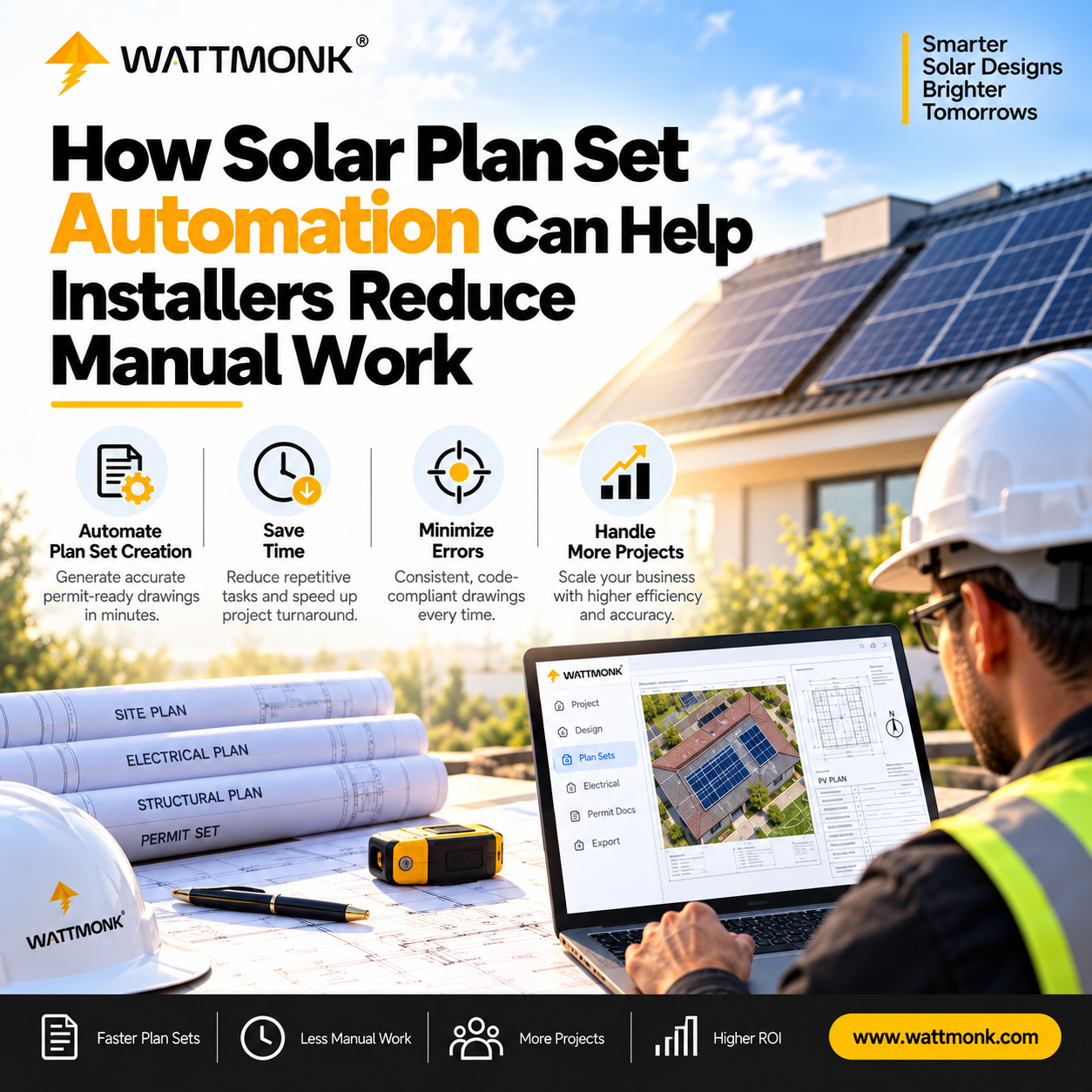
The shift isn't "we now use software." The shift is what your team stops doing. They stop manually cross-referencing AHJ checklists for every project. They stop formatting spec sheets in a separate application. They stop catching equipment mismatches by memory. They stop annotating PDFs in a tool that isn't connected to the solar design workflow.
For a team doing 40 solar PV design packages per month, removing those manual steps across every project adds up to meaningful capacity. Not theoretical capacity - actual hours that shift from preparation work to project throughput.
Teams that have moved solar system design through PlanSetIQ have seen project cycle times improve by 10 to 20 percent. The same ops team handles more volume. The same solar designers move more projects. The capacity ceiling shifts upward without a proportional increase in headcount.
Self-Serve, Done-for-You, or Dedicated Designer
PlanSetIQ offers three ways to work:
- Self-serve: Your team runs solar system designs through the platform directly. Copilot guides each step. Pricing starts at $35/design with a free trial of three complete PV system designs
- Done-for-you: Upload the project files. WattMonk completes the full solar permit design using PlanSetIQ, with QC included. Available at $30/design for teams that want output without operating the platform themselves.
- Dedicated designer: A dedicated PlanSetIQ operator works as an extension of your team. From $1,499/month. Built for teams running consistent volume who want solar design capacity without hiring.
All three options give you the same QC layer, validated against 12,000+ AHJs
FAQs: Solar System Design
Q1. What is the difference between solar system design and a permit package?
Solar system design refers to the technical drawing process — creating the site layout, single-line diagram, and equipment documentation for a PV system. The permit package is the complete submission-ready deliverable that includes the solar system design plus all supporting documentation required by the AHJ and utility for permit approval.
Q2. How long does solar system design take?
Design time varies by team capacity and workflow. Manual solar system design using traditional drafting tools typically takes several hours per project. With PlanSetIQ's Copilot-guided workflow, teams consistently move from upload to permit-ready plan set in hours rather than days.
Q3. What is an AHJ and why does it matter for solar system design?
AHJ stands for Authority Having Jurisdiction — the local government body responsible for reviewing and approving solar permit packages. Each AHJ has its own requirements for what a solar system design must include, how it must be formatted, and what NEC compliance standards apply. PlanSetIQ maps each project to the specific requirements of the receiving AHJ automatically.
Q4. What causes solar system design errors at submission?
The most common causes are equipment mismatches between documents, missing NEC compliance labels, setback errors, incomplete utility interconnection documentation, and spec sheet formatting issues. These are the failure points PlanSetIQ's automated QC checks for before a package leaves the platform.
Q5. What does solar permit package management involve?
Solar permit package management covers the end-to-end process of preparing, submitting, tracking, and revising the documentation required for AHJ and utility approval of a PV system installation. It includes coordinating the solar system design, equipment documentation, interconnection applications, and responding to AHJ correction notices.
Run One Real Project
The best way to understand the difference isn't a demo. It's running a project you already have. Start with the free trial of two complete solar plan sets, full features, no commitment. See the output on your actual projects before making any decision.
Explore Related Insights
Explore the Solar Engineering & Technology World
From solar plan sets and PE stamping to AI-powered design tools and permitting insights — explore pieces written for solar professionals navigating the technical and technology side of the solar industry.