
How Solar Plan Set Automation Can Help Installers Reduce Manual Work

Insights
How Solar Panel Efficiency Impacts Plan Set Design, String Sizing, and Client Proposals
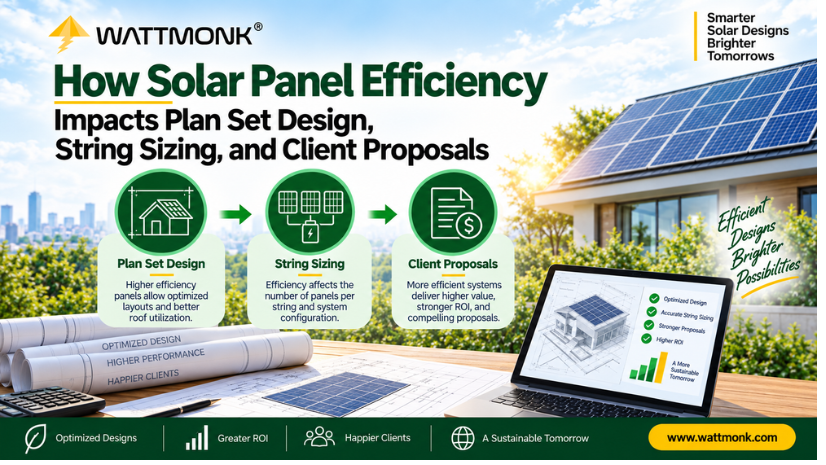
Efficiency ratings get thrown around a lot in solar sales conversations - but for installers and EPCs, efficiency isn't just a marketing number. It directly shapes how you design a system, how you size your strings, what structural loads you're working with, and how you justify your proposal to a client who's comparing quotes.
This guide breaks down solar panel efficiency from a design and engineering lens - the decisions that actually happen on your desk between a site survey and a permit-ready plan set.
Why Efficiency Matters More at the Design Stage Than the Sales Stage
Sales teams sell efficiency as a headline number. Designers have to translate that number into a working system that fits a real roof, meets NEC requirements, and satisfies the AHJ. That means efficiency touches almost every stage of your workflow:
- Module count and layout — higher efficiency means fewer panels for the same target output, changing your array layout and mounting plan
- String sizing and voltage calculations — efficiency and wattage together determine Voc/Isc values that drive your string sizing configuration
- Structural loading — fewer, higher-wattage panels change wind and snow load distribution across the array, tied to your structural calculations
- Permitting and plan set accuracy — AHJs scrutinize module specs closely; using outdated or approximate efficiency data is a common source of rejected plan sets
The Efficiency Formula — and Where Designers Actually Use It
Panel efficiency is measured under Standard Test Conditions (STC): 25°C cell temperature, 1000 W/m² irradiance, and an air mass of 1.5.
Efficiency = (Pmax / Area) / 1000 × 100%
For most day-to-day design work, you won't calculate this from scratch — it's on the datasheet. But it becomes critical when:
- Comparing modules for a space-constrained roof. Two panels with the same wattage can have very different footprints depending on efficiency, which changes how many strings fit in the available array area.
- Validating a client's expectations against a datasheet. Homeowners frequently ask why their "25% efficient" panel doesn't seem to be producing at that rate — a good opportunity to explain STC vs. real-world (NOCT) conditions in the proposal.
- Auditing incoming project specs from sales teams before they reach a designer, to catch mismatched module assumptions early.
Real-World Output vs. STC Rating: What to Flag in Every Design
A module's STC efficiency is a lab number. Real rooftops rarely hit 25°C — most operate closer to 50–65°C depending on climate and roof mounting. This is where the temperature coefficient becomes as important as the efficiency percentage itself.
Consideration Design Impact Temperature coefficient A panel with a weaker coefficient can underperform a lower-efficiency panel in hot climates — factor this into production estimates, especially for AZ, TX, NV projects Degradation rate Compounds over 25 years; affects long-term production modeling in the proposal Shading and soiling losses Efficiency on paper assumes clean, unshaded conditions — site survey data should adjust expected output accordingly Mounting and ventilation Rooftop mounting with poor airflow raises operating temperature, reducing effective output below rated efficiency
Flagging these in your plan set notes and proposal documentation helps set accurate client expectations and reduces post-installation disputes over "underperforming" systems.
Cell Technology and What It Means for Your Design Workflow
The efficiency ceiling has moved quickly. As of 2026, back-contact cell architectures (ABC, HPBC 2.0) lead the residential market at up to 25% efficiency, with N-type TOP Con modules close behind in the 23–24% range and dominating high-volume production.
Cell Technology Typical Efficiency Design Note Monocry stalline (standard)18–22%Standard string sizing calculations apply N-type TOPCon22–24%Slightly better temperature coefficients — favorable for hot-climate projects Back-contact (ABC / HPBC 2.0)Up to 25%Higher power density per panel — recalculate array layout and rafter spacing before assuming a like-for-like swap with older modulesPolycrystalline13–16%Increasingly rare in new residential design; larger footprint for same outputThin-film7–13%Rarely used in standard residential plan sets; relevant mainly for unconventional mounting surfaces
When a client requests a higher-efficiency module mid-project — a common scenario — don't assume it's a drop-in replacement. Higher-efficiency panels often come in different physical dimensions and weights, which can shift your structural calculations (wind/snow load per ASCE 7) and require a fresh string sizing pass.
Efficiency's Role in the Client Proposal
For sales and design teams building the proposal together, efficiency is most useful as a space-vs-cost conversation, not a standalone selling point:
- Space-constrained roofs: Higher efficiency panels let you hit a production target with fewer panels — useful when roof area is the limiting factor, not budget.
- Ample roof space: A mid-efficiency, lower-cost panel can often meet the same production goal at lower system cost — worth presenting as an alternative, especially for cost-sensitive homeowners.
- Comparing quotes: Homeowners often compare efficiency percentages across quotes without understanding wattage, temperature coefficient, or degradation differences. A short, plain-language efficiency explainer in the proposal reduces back-and-forth and builds trust.
Common Plan Set Mistakes Tied to Efficiency Data
A few recurring issues we see across plan set reviews:
- Using outdated module datasheets - efficiency and dimension specs change between hardware revisions of the "same" panel model
- Not adjusting string sizing when a client swaps to a higher-efficiency, higher-voltage module mid-project
- Ignoring temperature derating in production estimates, leading to proposals that overpromise annual output
- Structural assumptions carried over from a lower-wattage module layout without re-verification via updated structural calculations
Catching these before submission is one of the more common reasons plan sets bounce back from AHJ review.
The Bottom Line
Efficiency is a useful shorthand for comparing modules, but for installers and EPCs it's really a proxy for several design decisions at once — module count, string configuration, structural loads, and realistic production estimates. Treating it as a single headline number in a proposal (without the supporting engineering context) is where most client expectation mismatches start.
Building efficiency data directly into your site survey, plan set review, and proposal workflow — rather than treating it as a sales afterthought — is what keeps projects moving through permitting without rework.
Explore Related Insights
Explore the Solar Engineering & Technology World
From solar plan sets and PE stamping to AI-powered design tools and permitting insights — explore pieces written for solar professionals navigating the technical and technology side of the solar industry.